
不平视者:The One Who Cannot Look Level
在洛达纳·卡弗尔,人们不敢直呼它的名字,因为名字是平辈之间的称呼,而它从不与任何人平辈。它们唤它”上面那位”——可这并不准确,它既在上面,也在下面,唯独不在你的对面。
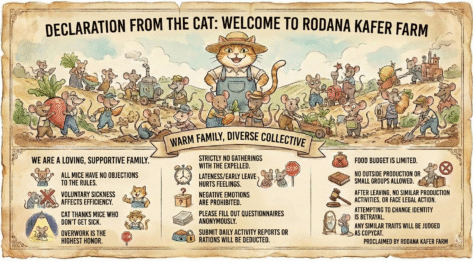
In Rodana Kafer, no one dares speak its name aloud, for a name is what equals call one another, and it has never been any creature’s equal. They call it “the One Above” – though this is not quite right, for it is above you and below you both, and the one place it never is, is across from you.
它司掌一切有高下之处。凡有谁抬起头,凡有谁低下头,凡”尊”与”卑”在同一个房间里短暂成立,便是它降临的时刻。它不司掌善,也不司掌恶,它只司掌差等。据说在它的辖境之内,没有”旁边”这个方位;万物非上即下,并列与邻接对它而言是一种盲色。
It presides over all things that have a high and a low. Whenever someone lifts their head, whenever someone bows it, whenever “superior” and “inferior” hold true, however briefly, within a single room – that is the moment of its coming. It presides over neither good nor evil; it presides only over rank. Within its dominion, they say, there is no such direction as “beside.” All things are either above or below; sidedness and adjacency are, to it, a color it was born blind to.
它是一只黑色的、过分肥胖的猫,无足,终日悬浮,在世界的各个地方辗转,似乎没有落脚之日。脸上没有眼睛——因为脸是用来与人相对的,而它从不相对。背上仅有的一只眼睛,只看得见高过它的、在它之上的存在,望向那些的时候,它温顺、谦卑,近乎虔诚。腹下却缀满了眼睛,密密麻麻,其中不乏后来安上去的义眼,昼夜扫视低处的每一个角落,俯视的时候,它威严。腹下垂着不知是毛还是触须的东西,上面常拴着几只小动物,被它带着一同悬浮,一同巡视。它一生只有两种姿态:仰望,或俯瞰。它无法平视任何人——是视野的残缺,还是天性使然,无人知晓。
It is a black cat, grotesquely fat, footless, forever suspended in the air, drifting from one corner of the world to another as though it would never find a place to land. Its face holds no eyes – for a face is what one turns toward another, and it turns toward no one. The single eye set in its back can see only what rises higher than itself, what stands above it; and when it gazes up at such things, it is meek, humble, very nearly devout. But its underside is studded with eyes, dense and countless, no few of them artificial ones fitted on later, sweeping every low corner day and night; and when it looks down, it is sovereign. From its belly hang strands of something – no one knows whether fur or feelers – and small creatures are often tethered to them, carried along as it drifts, made to patrol the world at its side. All its life it has held only two postures: looking up, or looking down. It cannot look at anyone level – whether this is a defect of its sight or of its nature, no one knows.
然而真正使人惧怕它的,并不是它的样子,而是它开口之后的事。
Yet what truly makes people fear it is not how it looks, but what happens once it speaks.
凡是与它长久交谈的,都会慢慢染上同一种病。先是怀疑自己的记忆——”你记错了,我从没那么说过。”再是替它的情绪担起责来——”你是一个让别人感到不适的人。”最后,是再也无法在它不看自己的时候,确认自己还存在。这最后一样最是要命。它让人相信:你唯有被它腹下的眼睛看见,才算真正活着;而它的注视永远向下,于是你每被它确认一次,就矮一分。长久以来你逐渐被弱化,虽然那些垂下的毛发一点也不坚韧,你却忘了自己可以轻而易举地从中逃脱。人人都明白这道理,却仍争先恐后地挤到它腹下去,因为顺着那些下垂的毛发淌出的油脂,虽不至于让人饿死,但只要你愿意减少自己的胃口,就能够跟着它果腹。
All who talk with it long enough come to take the same sickness. First they doubt their own memory – “You’re misremembering; I never said that.” Then they begin to answer for its moods – “You are the kind of person who makes others uncomfortable.” And at last they can no longer confirm that they exist at all, in any moment it is not looking at them. This last symptom is the deadliest. It makes you believe that you are only truly alive when seen by the eyes on its belly; and since its gaze is forever cast downward, each time it confirms that you exist, you shrink a little lower. Over time you are worn thinner and thinner — and though those hanging strands are not the least bit strong, you forget that you could slip free of them with ease. Everyone understands this, and still they crowd and jostle to press in beneath its belly, because down along those drooping strands seeps a grease that, while it will not save you from starving, is enough to keep you fed as you follow along – so long as you are willing to want less and less.
它常常传递的,是那些前后矛盾的悖论。它说这样的话,不为讲明什么,只为让人在里头打转——转着转着,人就丢了立足的地方,最后连”我是谁”这件事,也一并交到它手里裁夺。
What it most often hands out are paradoxes, statements that turn against themselves. It speaks this way not to make anything clear, but to set a person spinning inside the words — and round and round they go, until they lose the ground beneath their feet, and hand over even the matter of “who am I” for it to rule upon.
它最得意的一句,是说自己是这世上唯一真正看得见你的。别人看你,看的是你的位置;唯有它,看的是你本人。没有谁敢提醒它:它的眼睛长在肚子上,它能看你的方式,只有俯视;它这一生,从未真正与任何人对视过。它说它最懂你,而它连平视你都做不到——这两件事如何并存,它从不解释,也没有人敢问。
Its proudest claim is that it is the only thing in all the world that truly sees you. Others, when they look at you, see your position; it alone sees you yourself. No one dares remind it that its eyes are set in its belly, that the only way it can see you is from above, that in its whole life it has never once met another’s gaze. It says it understands you best of all – and it cannot so much as look at you level. How both of these can be true at once, it never explains, and no one dares to ask.
至于这一切是谁记下的、又是谁准许记下的,洛达纳·卡弗尔有一种说法,说农场里所有的规矩、所有关于它的记载、连同那句”它是安全的、温顺的、一切尽在它掌握”的断语,都出自农场的管理者之手。而那位管理者,自始至终,只有它一个。它替自己写下”无害”,替自己盖了章,并认为这中间没有任何问题。
As for who set all this down, and who gave leave for it to be set down – in Rodana Kafer there is a saying: that every rule of the farm, every record kept of it, together with the verdict that “it is safe, it is gentle, it has everything well in hand,” came from the hand of the farm’s keeper. And that keeper, from first to last, has only ever been it. It wrote “harmless” for itself, stamped its own seal upon itself, and saw nothing amiss in this at all.
它至今不曾跌倒。负重如此,悬于半空,看不见自己落脚的地方,却始终安稳。它说这是它的本事,旁人说这是运气。那么我们仍要悄悄替它祈祷:愿它永远不要被什么绊倒;尤其愿它,在绊倒的那一刻,第一次、也是最后一次,看清自己的脚。
To this day it has never fallen. Bearing such weight, hung in midair, unable to see the ground it would set down upon, it remains forever steady. It says this is its own skill; others say it is luck. So still we pray for it, quietly: that it may never be tripped by anything – and above all, that in the instant it trips, it may, for the first time and the last, see its own feet.
长生道(The Way of Long Life)
在洛达纳·卡弗尔的深处,有一座鸡舍。鸡舍里没有笼子,只有一条条金属的传送带,纵横交错,分岔又汇合,像谁随手画下、又忘了擦去的脉络。带上跑着的,是一群穿西装的鸡。它们衣冠齐整,系着领带,挂着工牌,低着头,攥着拳,一刻不停地往前跑。
它们已经跑了太久,久到忘了这传送带本来是用来运送什么的。它们把它当成了跑步机。
它们说,这是为了锻炼,为了健康,为了把自己活得更好一些。跑得越久,越觉得自己强壮;跑得越快,越觉得自己上进。它们之间也比,比谁跑得更勤,谁的姿势更标准,谁脸上的汗流得更体面。跑得最好的那几只,会被请到带子的高处,戴上花,称作健康的楷模,供其余的鸡仰望、效法。没有谁注意到,那几只楷模,恰恰是最先抵达带子尽头的。
而带子的尽头,立着一排刀片。
跑步机的诚实,在于它哪儿也不去;传送带的残忍,在于它真的带你去某个地方。它们偏偏把后者认成了前者。于是它们越勤勉,离刀刃越近,而这越来越近的距离,被它们唤作”进步”。它们以为自己在原地变强,其实是在加速赴死——脚下每一步的力气,都老老实实地花在了缩短自己与那把刀的距离上。
传送带是分岔的,于是它们以为自己在选路。这条通往哪里,那条又通往哪里,它们认真地比较、权衡,为选错而懊悔,为选对而自得。没有谁告诉它们:每一条岔路的尽头,立着的都是同一排刀片。选择是真的,只不过选的从来不是去哪儿,而是从哪一把刀下面过去。
最奇怪的是,这传送带并不高,两侧也没有墙。任何一只鸡,只要肯停下脚步,侧身一跨,就能从带子上下来。带子不会拦它,刀片也够不着它。可是没有谁下来。因为在这座鸡舍的道理里,停下就是懒惰,下来就是认输,不跑就是不爱惜自己的身体——而一只不爱惜健康的鸡,是要被同伴看不起的。捆住它们的从来不是带子,是”要健康”这三个字。它们忘了,自己随时可以不那么健康地、却安然地活着。
至于在它们头顶,墙的最高处,站着另外一些西装革履的东西,捧着发光的板子,低头看着这一切。它们不跑,也不必跑,它们的脚从不沾带子。它们望着满舍的鸡奔向刀片,在板子上记下今天又有几只达标,神情专注而满意。它们俯视下面的鸡时居高临下,想要仰望更高处时——可惜这鸡舍已是最高,它们头顶空无一物,那道仰望的目光便只好悬在半空,无处安放。
凡有高下之处,皆是那位的辖境。这座鸡舍,自然也落在它腹下的眼睛里。
它们至今仍在跑。那么我们便替它们祈祷吧:愿它们脚下的带子永远不要走到尽头;又或者,愿它们之中能有一只,在某个不那么努力的清晨,忽然停了下来,侧过身,若无其事地跨了下去——然后惊讶地发现,地面是稳的,刀片是远的,而它什么也没有失去。